Smart Energy Materials and Systems Lab


Perovskite for Solar Cells
Halide perovskites are a family of materials that have shown potential for high performance and low production costs in solar cells. Perovskite solar cells have shown remarkable progress in recent years with rapid increases in efficiency, from reports of about 3% in 2009 to over 25% today. While perovskite solar cells have become highly efficient in a very short time, a number of challenges remain before they can become a competitive commercial technology. We are working on the study of the structural and electronic properties of these materials as well as the fabrication of perovskite thin films.
Research Publications
Some of the highlighted research publications
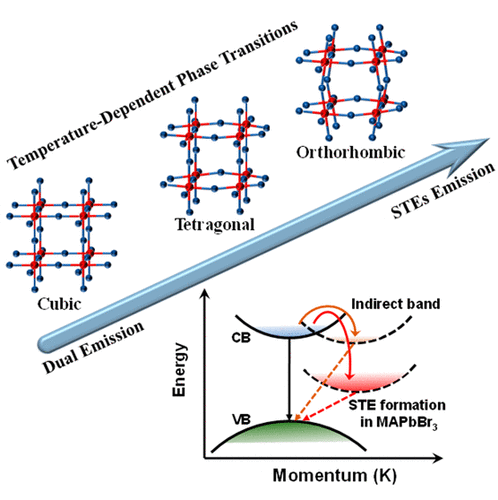
J. Phys. Chem. Lett. 2024, 15, 9, 2557–2565
The optoelectronic properties of organic lead halide perovskites (OLHPs) strongly depend on their underlying crystal symmetry and dynamics. Here, we exploit temperature-dependent synchrotron powder X-ray diffraction and temperature-dependent photoluminescence to investigate how the subtle structural changes happening in the pure and mixed A-site cation MA1–xFAxPbBr3 (x = 0, 0.5, and 1) systems influences their optoelectronic properties. Diffraction investigations reveal a cubic structure at high temperatures and tetragonal and orthorhombic structures with octahedral distortion at low temperatures. Steady state photoluminescence and time correlated single photon counting study reveals that the dual emission behavior of these OLHPs is due to the direct-indirect band formation. In the orthorhombic phase of MAPbBr3, the indirect band is dominated by self-trapped exciton (STE) emission due to the higher-order lattice distortions of PbBr6 octahedra. Our findings provide a comprehensive explanation of the dual emission behavior of OLHPs while also providing a rationale for previous experimental observations.

J. Phys. Chem. C 2023, 127, 51, 24608–24617
The octahedral distortion plays a pivotal role in
influencing various unique electrical and optical properties of
organic lead halide perovskites (OLHPs). Unveiling the nature of
the response of the local inorganic octahedra to the photophysical
properties is a critical step toward understanding the formation of
excited-state defects. Here, we report a fundamental understanding
of the process of octahedral distortion and its variation with
temperature in MA1−xFAxPbBr3 (x = 0, 0.5, 1) perovskites. Further,
the origin of trap states which are responsible for the broadband
emission has been elucidated with the help of detailed structural and
photophysical analysis. We find that the intensity and Stoke shift of
the broadband emission peaks and charge carrier dynamics are
significantly influenced by the changes in Pb−Br bond lengths and
Pb−Br−Pb angles. Our findings highlight the relationship between the octahedral distortion and the formation of trap states and
provide further insights into tailoring the broadband emission by regulating the local inorganic octahedra in OLHPs.

J. Phys. Chem. A 120, 9732–9739
Hybrid organic–inorganic metal halides of the type CH3NH3PbX3 have emerged as potential materials for photovoltaic applications. In this paper we discuss structural, electronic, and optical spectroscopy investigations performed on high quality single crystals of CH3NH3PbI3. Our results conclusively suggest that CH3NH3PbI3 crystallizes in centrosymmetric space group and the methylammonium moiety exhibits disordered packing at room temperature. Extracted values of the exciton binding energy, the electron–phonon coupling constant, and the schematic energy level diagram constructed from the emission broadening, Raman, and photoemission spectroscopy measurements clearly show the potential of this system in photovoltaic applications.